
-
Latest News & Insights
Latest News & Insights
Arab National Bank and Europe Arab Bank,discover more
ABA Sponsors for 2026

Oral History
The period since the ABA was founded in London in 1980, has been one of immense change, both in the Arab world and the sphere of international finance. During this time Arab banks have played a pivotal role, not just in the development of their sector, but also in the deployment of Arab capital, critically determining the pace – and sometimes the direction – of the region’s development.
Many senior members of the ABA have been uniquely placed to observe some of these events at first hand.
In these pages we will be posting a series of occasional interviews with former ABA members, in which they discuss their work and the role they played in shaping the economic development of the Arab world.
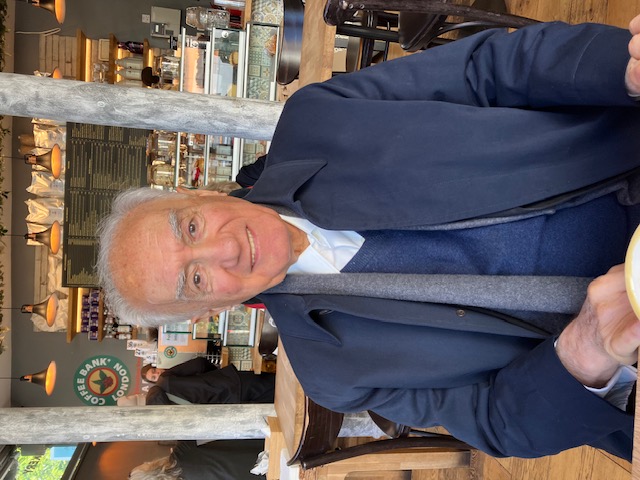
Elie Elhadj
Midwife to the birth of Islamic Banking in Saudi Arabia
Today, the global Islamic financial services industry is estimated to be worth $3.88 trillion, with some predicting its value will increase to as much as $7.5 trillion by 2029. The field is dominated by the Kingdom of Saudi Arabia which hosts the world’s largest Islamic finance market, worth an estimated $826 billion.
As part of our series of oral history interviews with significant figures from the ABA’s past, founding member of the ABA and former Arab Banker Magazine Editor, Elie Elhadj, (1980 - 1986) recalls the formative part that he played in establishing the first Islamic banking institution in Saudi Arabia, Alrajhi Bank.
The 1973 increase in oil prices created an enormous economic boom in Saudi Arabia. The country became host to millions of workers from Arab countries, Bangladesh, India, Indonesia, Pakistan, the Philippines, among others. Remittances from expatriate workers to their home countries became a massive business. By the early 1980s, dozens of money changers had sprung up.
In 1980, Alrajhi Company for Currency Exchange and Commerce (ARCECC), was possibly the largest privately owned company in Saudi Arabia. It had $160 million in paid-up capital and 150 money changing and general trading branches.
The company was owned by four Alrajhi brothers, in order of age, Saleh (the chairman), Abdullah, Sulaiman (the managing director and majority shareholder with 42% of the equity), and Muhammad. The company took customer deposits and transferred money around the world through a network of correspondent banks. To comply with Shari’a laws, customer deposits did not earn interest. ARCCEC deployed its liquidity in precious metals and currency trading. It also placed funds in bank deposits with the interest given to charity. ARCCEC’s reputation for safety, efficiency, and competitive pricing was dominant and led to a balance sheet in billions of Riyals. But since the company was not a bank, it was outside the supervision of Saudi Arabia’s Central Bank, the Saudi Arabian Monetary Agency (SAMA).
The Saudi government was concerned that an important financial industry was largely unregulated and had started a process to regulate the money changers in the late 1970s. This became urgent in 1982, after the money changing business of Abdullah Saleh Alrajhi, a son of ARCCEC’s Chairman, had failed. The son had created a sizeable network of 40 branches in competition with the company of his father and uncles and the failure was caused by speculation in silver. It resulted in default of over $250 million to precious metals dealers in European banks and to tens of thousands of expatriate workers who remitted their wages through the failed company. It caused a huge stir in banking circles in Saudi Arabia, Europe, and the home countries of the remitters and tarnished the reputation of Saudi money management.
Advising Sheikh Sulaiman Alrajhi
Regulating the money changers involved banning them from taking customers’ deposits. As a result, ARCCEC, was required to separate its general trading business from money changing and turn the latter into a bank under SAMA’s supervision.
I was working at the London office of Philadelphia National Bank at the time and Sheikh Suleiman was one of my customers. I’ve never met anyone quite like Suleiman Al Rajhi. He was an extraordinary self-educated and self-made giant of a man.
Sheikh Sulaiman did not want this new bank to be just one more conventional bank in Saudi Arabia. He wanted an Islamic bank. But to operate in an interest-free environment, he had to convince SAMA that the future bank would have the capacity to create safe Islamic assets. In May 1980, during a visit to Riyadh he revealed to me his strategy and asked me to think of ways to create Islamic assets.
I said to myself, when was the last invention in banking? Probably when the Italians invented the bankers draft! Commercial banking is conservative and rather unimaginative. You can't be too creative in banking, because if you are, you risk losing the sacred trust of your depositors. So this felt like a life-time opportunity for me – and a unique privilege to work on introducing a new banking instrument to the market. But there were many challenging issues to be considered.
With help from an accomplished Arthur Young tax specialist, Larry Chrisfield, it was decided that an advisory company in London would be the most efficient structure. It would create a non-interest-bearing legal contract, market the product, and assess the commercial risk of counterparties. The London company would then recommend to the ARCCEC Credit Committee the establishment of credit limits and prepare the contracts for signing by the ARCCEC in Riyadh. Paying and receiving of funds and booking transactions would be done in in Riyadh in the normal course of ARCCEC’s procedures.
The London operation did not need much capital, just enough for desks, word processors, an IBM 36, and Telex machines. Its tax bill in the UK would be rather small. Indeed, such a function could have been placed in Riyadh, but London was better suited to access lawyers, tax specialists, risk analysts, and for marketing the new products in Europe and beyond.
Arthur Young produced the memorandum and articles of association of the new company, which I translated into Arabic and a few weeks later I met with Sheikh Sulaiman in his Riyadh office. We spent all day going over every word and comma of the incorporation documents, after which he approved the formation of the Alrajhi Company for Islamic Investments Limited. The directors were to be the four Alrajhi brothers and myself.
Creating a Shari’a-compliant lending structure
We rented a 3,000 square-foot space in the just completed J. P. Morgan building complex at 2 Copthall Avenue in the City of London and we began operations on January 1, 1981.
A liaison office was established in Riyadh as part of ARCCEC’s International Division, to approve London’s credit-line recommendations, sign contracts, pay and receive funds, and book transactions. The international division was headed by Abdullah, Sheikh Sulaiman’s competent son.
But a Shari’a compliant return cannot accrue from the mere passage of time. Capital must be put to work to generate profit. Of course, safety of principal and return were paramount. Any loss would have jeopardized the viability of the new concept.
Since rental income and dividends involve long-term risk exposure, they were ruled out. Short-term trading was the choice. While a customer would typically borrow, say, $10,000 from a bank to purchase a car, ARCCEC would purchase the car from a supplier and sell it to the customer at a higher price on a deferred settlement of, say, twelve months. Called Murabaha, the difference between the purchase and sale prices represents trading profit.
The task was now to develop a contract that would protect ARCCEC’s legal rights and comply with Shari’a laws. A Murabaha contract should have three parties, a seller, ARCCEC, and a buyer. Furthermore, trading in certain goods, namely alcohol, pork-related products, tobacco, or weapons, is prohibited. Also, forward dealing in currencies and precious metals is not allowed since the difference between their spot and forward prices represents interest. These parameters were all approved by Sheikh Sulaiman and his Shari’a adviser.
The contract also had to be legally acceptable to international corporate customers and be simple to implement. I worked with a brilliant lawyer named Jamie Jowitt, of London law firm, Bischoff & Co. After many meetings we concluded that the new contract should be drawn up under English Law, along the lines of a Banker’s Acceptance (BA), but with a twist. The twist was for ARCCEC to own the goods involved in the transaction by taking title to them. While a conventional BA does not take title to the goods, Murabaha must. A 15-page agreement was produced. We called it the General Trading Agreement (GTA).
But taking title to goods was also potentially risky. If a serious accident were to cause damage to life and property while ARCCEC held the title, we would be pursued in the courts for compensation. So, the GTA specified that once title passed to ARCCEC from a supplier, it would immediately (scintilla temporis) pass to the buyers. I am pleased to say that the GTA guided other Islamic banks into documenting their own short-term trade-related financing.
Marketing the new product
ARCCEC had several billion dollars to deploy, so we were looking for engagement with large global companies in high commodity-linked sectors like oil, mining, chemicals, trading, and manufacturing, among others.
But before approaching a potential customer, the tax implications in the specific country had to be examined carefully. While the GTA was considered a trading activity by one taxing authority, in other jurisdictions it was viewed as financing. Trading or financing would mean different tax treatment for Alrajhi. For the counterparties, the GTA had two important advantages.
The first was balance sheet attraction. Although the accounting treatment was left to the customer, the obligation to pay for the goods under a GTA could be booked on the liabilities side of the balance sheet as account payable instead of bank borrowing. An account payable entry improves balance sheet ratios.
The second advantage was pricing. A bank loan was typically priced at the London Interbank Offered Rate (LIBOR) plus a spread. ARCCEC’s pricing was based on the London Interbank Bid Rate (LIBID) without a spread. A GTA transaction saved the customer around a quarter of one percent in financing costs.
Seven years later, by the end of 1987, ARCCEC’s customers list included 30 of the 50 largest corporations in Europe, and Japan’s biggest trading companies. Credit facilities were $6 billion with outstanding balances more than $3 billion. During these years, thousands of transactions were completed without a penny lost. Behind the numbers stood three seasoned banker colleagues: Peter Butler, John Carney, and Barry Noton.
With the formation in 1988, of Alrajhi Banking and Investment Corporation, renamed as Alrajhi Bank in 2006, my task was complete. My years with Alrajhi were the most intellectually exciting and exhilarating of my career.
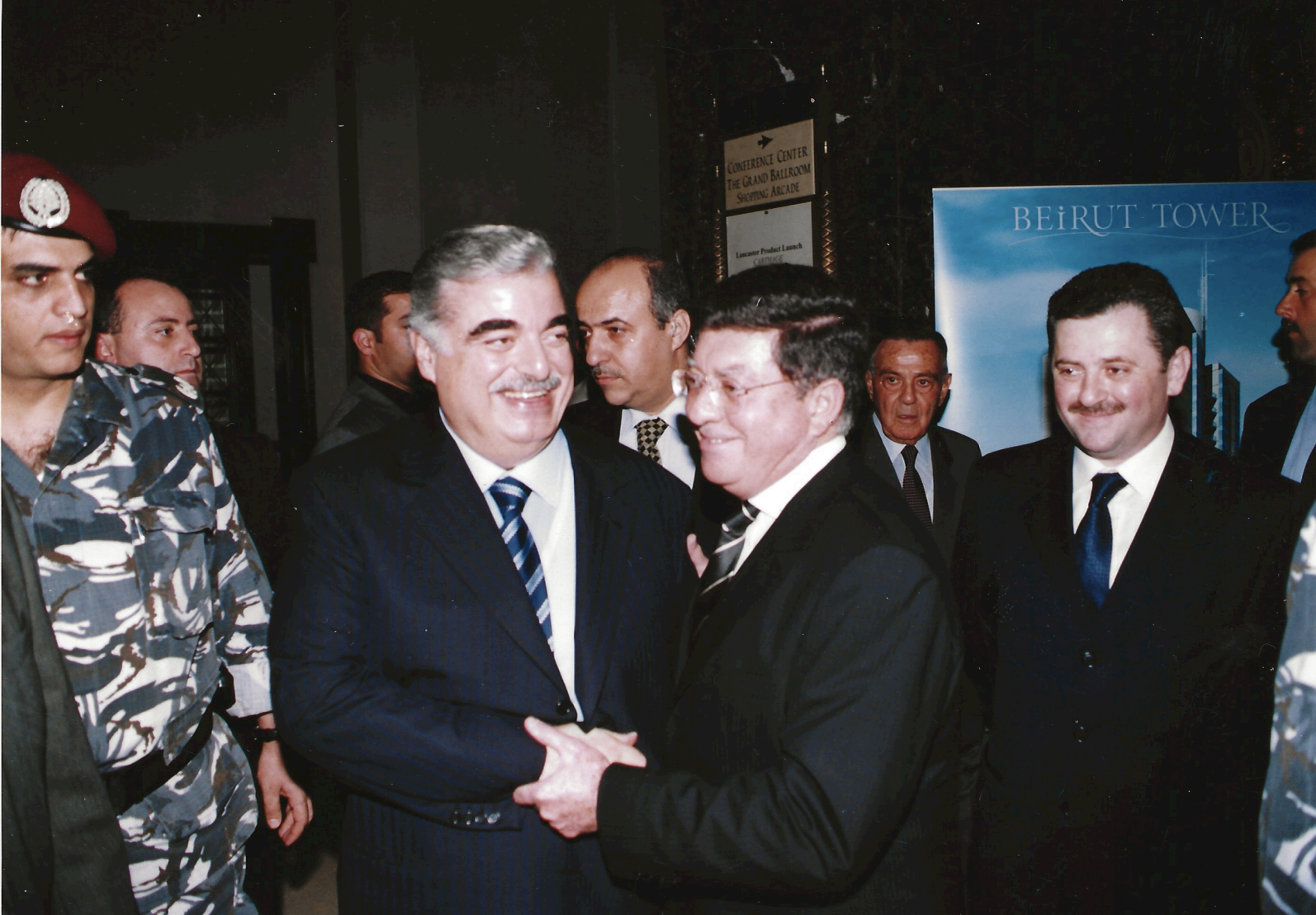
Faisal Kudsi with Lebanese Prime Minister Rafic Hariri.
Witness to A Quiet Revolution
Faisal Kudsi, one of the founder members of the ABA, recalls public perceptions of Arab banking immediately before the ABA’s establishment and the key role the Association played in changing the relationship between Western economies and Arab finance.
Before the 1973 war in the Middle East the oil price had been about two dollars per barrel. By the end of the war, it had jumped to around twelve dollars. As a result, and because of the inflation that followed, between 1971 and 1979, the Dow Jones Index declined by about 50%, something which in turn caused a severe economic recession in Western economies. At the time this was generally blamed on “the Arabs”. In actual fact, oil production in the Arabian Gulf was a lot cheaper than it was in either the North Sea or the United States. All that happened was that Arab governments had decided to raise their prices to comparable levels.
At that time, I was in Beirut working for the Arab Bank. Most of my time professionally and socially was spent meeting Western bankers who were trying to get business for their banks via the new wealth that was being generated in the Gulf countries, what was known as petro-dollars.
The few Arab banks that existed at that time were considered to be a bridgehead between governments that were receiving petro dollars and those Western banks that were looking for business. The Western banks had more or less assumed that Arab banks couldn’t handle the amounts of money that were being generated. At this point, the few Arab banks that were able to do so informed their Western colleagues that they would like to recycle the petro dollars by working together, a move which prompted more Arab banks to establish an international presence in Europe and New York.
Fifty years ago, the Arab world was not as developed as it is now, especially the Gulf countries.When I went to Riyadh for the first time towards the end of 1977, it was little more than half the size of Beirut or Damascus. There were few hotels and I once had to sleep in the reception area of the Waha Hotel as all their rooms had been booked. The older generation of Gulf Arabs were more welcoming to non-Gulf Arab bankers then than they are today. At that time, we were all Arabs and in the same boat.
But with Western Bankers descending on Riyadh in droves, they slowly began to realise the need for funds to be used for internal economic development. By the mid-eighties, all talk of recycling petro dollars had slowly faded away.
Arab Bank
The founder of the Arab Bank, Al Hajj Abdul Hamid Shoman, had been a friend of my father. He was originally a stone mason from Palestine who migrated to New York at the beginning of the last century. On his return home, some thirty years later, he established the Arab Bank Limited with the wealth that he made in America. He used to tell us that it takes fifty years to build a bank and five years to break it. Building a bank is a very slow process and you can only do so with bankers who are 100% honest and transparent, otherwise the bank will disappear with time. My elder brother then became the head of Arab Bank’s computer department at its head office in Amman, and over lunch at our home in Beirut in 1973, Mr Shoman senior commented to my father that the fact that I wasn’t also working for Arab Bank, brought shame to our family. I was working for Merrill Lynch at the time, and I had to accept a reduction of 50% in my salary to join Arab Bank! I joined just after the October 1973 war and that same year the bank decided to establish an investment banking division in London. So, in February 1976 I moved to London as its head.
There were no more than around 70 Arab bankers in London at that time, and very few Arab investment bankers. Arab Bank had opened in 1974, there was also Rafidain Bank which was a government bank from Iraq, and the consortium banks: Gulf International Bank and Union du Banque Arab et Francais (UBAF). The consortium banks were mostly involved in recycling petro dollars through syndicated loans, an activity that would prove quite costly to Arab banks later on.
By June 1977, I’d decided to leave Arab Bank and start a boutique investment banking company in partnership with the Gefinor Group. It was called Capital Guidance Limited. We were one of only three Arab entities in the investment banking field operating out of London.
Establishment of the ABA
In 1978/79, I was amongst a handful of Arab bankers that decided to establish a professional Arab Bankers Association. The original purpose was to establish a standard of reference for banking ethics, knowledge and norms of behaviour for individual bankers and it would represent us as individuals, rather than the institutions we worked with. The prime person behind the idea was the late Munir Haddad. He represented Dresner Bank which had originally been stationed in Beirut and then moved to London. He was a down to earth, elderly gentleman whose office was in Curzon Street very near to my own, we used to have lunch together at least once every week. The idea gathered support, I think, largely because he was such a likeable, charismatic person. The other movers were Bashir Zouheiri, Antoine Zananiri, Walid Niyazi, Elie Elhadjj and myself. All of them were employed as bankers except me, who by this time was self-employed, the CEO of my own company.
This was important because, as a self-employed person, I could speak my mind without any restrictions. It also gave me greater access and meant that I could meet ministers and high-ranking government officials back home on a one-to-one basis. In this respect I was able to push the story of the ABA, why we founded it and what its objectives were.
Not only were we able to provide the ABA’s first offices, but I was also able to devote a lot of my free time to working for the Association. In fact, the ABA’s founding charter was actually written in our offices at 7 Old Park Lane.
We only agreed on the Articles of Association after a lot of debate. The founding bankers chose a committee of four to agree on the articles: Antoine Zananiri, Walid Niyazi, Elie ElHadj, and myself.
At the time, a major issue for debate was how we defined an Arab banker. We limited membership to those whose parents were Arabs and created another membership category of associate member for non-Arab members and institutions. In retrospect I believe we were wrong to apply those very strict criteria.
Financial Security and Expansion
I served as a board member for two consecutive terms of three years and as head of the finance committee from 1981 to 1986. I went on a tour of Arab countries, at my own company’s expense, and we obtained funding of £50,000 from the Ministry of Finance in Saudi Arabia, which in 1982 was a big amount.
Within a period of two years, we had collected over a quarter of a million pounds from governments, and from banks that supported our aims, which I think in itself proves how well regarded and respected the Association was.
What also helped to raise our profile enormously were our annual conferences. They helped to create a professional forum for debate between bankers, government officials in the Middle East and the international community.
I was also involved in the ABA’s first gala dinner in 1982, with the main speaker being the Oil Minister of Saudi Arabia, Shiekh Ahmad Zaki Yammani. It was attended by about 400 delegates from all over the world. He was a good speaker and explained to the attendees and to the whole world really, the need for economic development in the Middle East. Of course, this also helped the association financially, since we charged a hefty attendance fee.
Both of these events moved the dial quite a lot in terms of attitudes to Arab banks. That first conference had led to the establishment of in New York of Arab Bankers Association of North America, which we considered a sister institution. The prime mover there was Mr Fakhruddin Khalil, Founding Director of UBAF.
Growth of Reputation and Prestige
The ABA was not only a professional association, it was one that aimed to establish the highest standards of honesty and transparency for the banking profession. It’s guiding principles were transparency and integrity.
The best of the board members academically was Elie ElHajj.We appointed him as editor of the ABA’s magazine. It contained news and analysis of banking issues, along with interviews with senior figures from big banks in the Middle East. It also generated good advertising revenue and Elie was highly selective about the subjects he covered and who he got to write about them. The magazine became very respected and helped to establish the ABA’s reputation for having the highest professional and ethical standing within the Arab banking sector. It helped to consolidate the reputation that the Association was aiming for and very soon it became a desirable thing for bank chairmen and general managers to be invited to become board members. It was regarded as something of a badge of honour, a professional achievement.